





Professor Jane Ginsburg will be speaking in Singapore at the inaugural lecture by IP Academy and the Singapore Management University’s Applied Research Centre for Intellectual Assets and the Law in Asia (ARCIALA). She will delve into the reciprocal relationship between copyright and trade mark law, and explore how differences in the nature and purpose of copyright and trade mark law permit the revival of dead copyrights as trade marks.
The IP Academy-ARCIALA IP Lecture is an annual series of seminars which feature well-known academics and practitioners in the field of intellectual property law.
Synopsis
US caselaw on trade mark once showed little tolerance for parodies and similar unauthorised “speech” uses of trade marks. Over time, however, the US copyright fair use doctrine has influenced the development of a trade mark parody defense.Trade mark law evolved a reciprocal relationship with copyright in other ways as well, potentially extending the protection of certain copyrighted works, notably cartoon characters, beyond the copyright term. Justice Scalia decried the resort to trade mark law to generate “a species of mutant copyright law that limits the public’s ‘federal right to “copy and to use,’ expired copyrights.” But differences in the nature and purpose of copyright and trade mark law in fact permit the revival of dead copyrights as trade marks. Copyright policy, however, may constrain the quantity of bodies that those zombies may snatch. Finally, as further evidence of copyright/trade mark reciprocity, the speaker will evoke a newer trend, the refashioning of trade mark symbols into copyrighted characters.
SPEAKER

Jane C. GINSBURG is the Morton L. Janklow Professor of Literary and Artistic Property Law at Columbia University School of Law, and Faculty Director of its Kernochan Center for Law, Media and the Arts. She teaches Legal Methods, Copyright Law, International Copyright Law, and Trademarks Law, and is the author or co-author of casebooks in all four subjects, as well as of many articles and book chapters on domestic and international copyright and trademark law. A graduate of the University of Chicago (BA 1976, MA 1977), Professor Ginsburg received a JD in 1980 from Harvard, and, as a Fulbright grantee, a Diplôme d'études approfondies in 1985, and a Doctorate of Law in 1995 from the University of Paris II. She is a Corresponding Fellow of the British Academy, a Member of the American Philosophical Society, a Member of the American Academy of Arts and Sciences, and an Honorary Fellow of Emmanuel College, University of Cambridge.
WELCOME ADDRESS

CHIAM Lu Lin is the Executive Director of the IP Academy (IPA). She is concurrently Deputy Chief Executive at the Intellectual Property Office of Singapore (IPOS). Lu Lin graduated from the National University of Singapore Law School. She joined the Singapore Legal Service and requested for a posting to the Legal Aid Bureau to work with those who could not afford their own lawyers. She was one of the key drivers in the conversion of IPOS into a Statutory Board. Lu Lin had also drafted a number of Intellectual Property (IP) legislations as well as issued Grounds of Decision on a number of IP cases. Lu Lin was the Chief Liaison Officer with WIPO and was Head of the Singapore Organising Committee for the WIPO Diplomatic Conference (DC) on the Revised Trademark Law Treaty. The DC culminated in the successful adoption of the Singapore Treaty on the Law of Trademarks and marked a historic and important milestone in Singapore's IP journey. Lu Lin oversaw the successful re-structuring of IPA to become the first subsidiary of IPOS with effect from 1 April 2012. As the Executive Director of IPA, she leads IPA in its vision to be a leading centre for excellence in Intellectual Property education.
INTRODUCTION

Daren TANG is the Chief Executive of IPOS. Prior to his appointment in 2015, Mr. Tang was IPOS’ Deputy Chief Executive (DCE) and helmed the Registries Cluster which was responsible for the development and operationalisation of Singapore’s IP regulatory framework. He oversaw the republic’s IP policy and legal regime development, and is currently co-leading major reviews of its copyright and design regimes. Mr. Tang represented Singapore in international IP negotiations with the World Intellectual Property Organization (WIPO). He also chaired the IP negotiations in major Free Trade Agreements, such as the Trans-Pacific Partnership (TPP) agreement, and the Regional Comprehensive Economic Partnership (RCEP) agreement. Formerly, he was a Senior State Counsel with the Attorney-General’s Chambers, where he led services negotiations in the US-Singapore FTA, and was part of the legal team that argued Singapore’s case before the International Court of Justice relating to the sovereignty of Pedra Branca. Mr. Tang holds a LL.B (2nd Upper, Hons) from the Faculty of Law, National University of Singapore, and an LL.M (with distinction) from the Georgetown University Law Centre, where he was also a Fellow of the Institute of International Economic Law. He attended the Harvard Business School Advanced Management Program in 2013.
DISCUSSANTS

Mark LIM is Senior Legal Counsel with the IP Academy of Singapore and the Intellectual Property Office of Singapore (IPOS). He currently heads the Hearings and Mediation Group at IPOS, provides legal advice for the IP Management for Public Agencies programme; and oversees the development and curation of training events in the area of IP law for the legal community in Singapore. Prior to joining IPOS in 2010, Mark was a lawyer in private practice for 15 years. At his last firm, a medium-sized law firm in Singapore, he established and headed the IP, Media & Entertainment Department. Mark's work encompassed all areas of IP law, including both contentious as well as non-contentious IP matters. Mark was also the Vice-Chairman for the Singapore Law Society’s IP Committee for several years. He has published many articles in both local and international journals, including the Singapore Academy of Law Journal, European Intellectual Property Review, Journal of International Arbitration, Copyright World and Trademark World. Mark is also a co-author of the volume on IP in Halsbury’s Laws of Singapore. He has been recognized as a leading IP lawyer in a number of international publications.

David LLEWELYN is Deputy Dean and Professor (Practice) in the School of Law, Singapore Management University and Professor of Intellectual Property Law, King’s College London. He is joint author of Kerly’s Law of Trade Marks and Trade Names (15th ed, 2011) and Cornish, Llewelyn & Aplin, Intellectual Property: Patents, Copyright, Trade Marks & Allied Rights (8th ed., 2013) and his business book “Invisible Gold in Asia: Creating Wealth through Intellectual Property” was published in 2010. Professor Llewelyn is a door tenant at 8 New Square in London through which he advises on international IP matters and accepts arbitration work in IP and technology-related disputes. Before moving to live in Singapore in 2010, as well as teaching on the London LLM since 1982, he practised as a solicitor in London for more than 25 years after qualifying with Linklaters and recently was the partner heading the European IP/IT practice at White & Case in London. From 2005 to 2007, Professor Llewelyn was the Director of the IP Academy Singapore and between 2007 and 2012 its Deputy Chairman & External Director.

TAN Tee Jim, SC is a Senior Partner and Head of the Intellectual Property and Technology Department of the firm of Lee & Lee in Singapore. He was called to the Singapore Bar in 1980 and appointed a Senior Counsel in 1999 by the Supreme Court of Singapore. He has advised and represented numerous clients on various Intellectual Property (IP) issues. Mr. Tan has spoken and written extensively on IP matters. He is the General Editor of Halsbury’s Laws of Singapore on “Intellectual Property” and is the author of the book “Law of Trade Marks and Passing Off in Singapore” (now in its 3rd edition). Mr. Tan is also a former President of the Association of Singapore Patent Agents, a former Vice-President of the Asian Patents Attorney Association and a founding member of the ASEAN Intellectual Property Association. He is also a Vice Chairman of the Copyright Tribunal of Singapore and a member of the Competition Appeal Board. He has been regularly cited as a leading IP lawyer in Singapore and Asia by various legal publications, including The Asia Pacific Legal 500, Global Counsel 3000, AsiaLaw Leading Lawyers, and Global Counsel's Intellectual Property Handbook. In The World's Leading Patent Practitioners 2013 handbook, he is described as "brilliant" and an "iconic figure" in patent litigation in Singapore.
MODERATOR

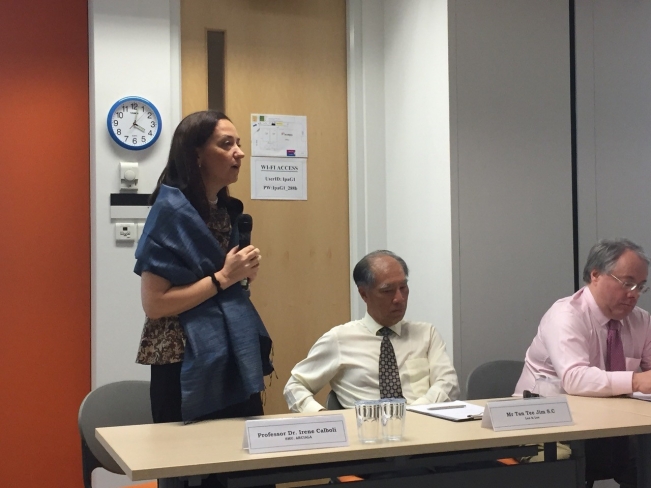
Irene CALBOLI is Lee Kong Chian Fellow, Visiting Professor, and Deputy Director of the Applied Research Centre for Intellectual Assets and the Law in Asia (ARCIALA), School of Law, Singapore Management University. She is also a Professor of Law at Texas A&M University School of Law. Professor Calboli started her academic career at the University of Bologna and has held visiting positions at the King’s College London, the University of California Berkeley, the University Complutense, and the Max-Planck-Institute for Innovation and Competition. From 2012 - 2015, she was a visiting professor at the Faculty of Law of the National University of Singapore. Professor Calboli's scholarship focuses on the intersection between intellectual property and international trade. Her recent books include THE LAW AND PRACTICE OF TRADEMARK TRANSACTIONS (Edward Elgar, 2016, with Jacques de Werra), and RESEARCH HANDBOOK ON INTELLECTUAL PROPERTY EXHAUSTION AND PARALLEL IMPORTS (Edward Elgar, 2016, with E. Lee).
CLOSING REMARKS

Kung-Chung LIU holds a Bachelor of Laws from National Taiwan University and a Doctor of Law degree from the Ludwig Maximilian Universitaet (University of Munich). In 1992, he joined Academia Sinica. In 2003, he was a Visiting Professor at the Faculty of Law of the National University of Singapore and also acted as Visiting Senior Research Fellow for the IP Academy of Singapore. He has served as one of the founding Commissioners of the National Communications Commission in Taiwan. In 2007, he was co-appointed Professor of the Institute of Law for Science and Technology, National Tsing Hua University. In 2010, he was co-appointed Professor of the Graduate Institute of Technology, Innovation & Intellectual Property Management, National Chengchi University. In 2014-15, he was a Visiting Professor at the School of Law, Singapore Management University, and the Founding Director of the Applied Research Centre for Intellectual Assets and the Law in Asia (ARCIALA). He is currently the External Director of ARCIALA.
Programme
2.00pm - 2.30pm: Registration
2.30pm - 2.35pm: Welcome Address by Ms. Chiam Lu Lin, Executive Director, IP Academy (IPA)
2.35pm - 2.40pm: Introduction by Mr. Daren Tang, Chief Executive, Intellectual Property Office of Singapore (IPOS)
2.40pm - 3.50pm: Lecture by Professor Jane Ginsburg, Morton L. Janklow Professor of Literary and Artistic Property Law, Columbia University School of Law
3.50pm - 4.05pm: Tea Break
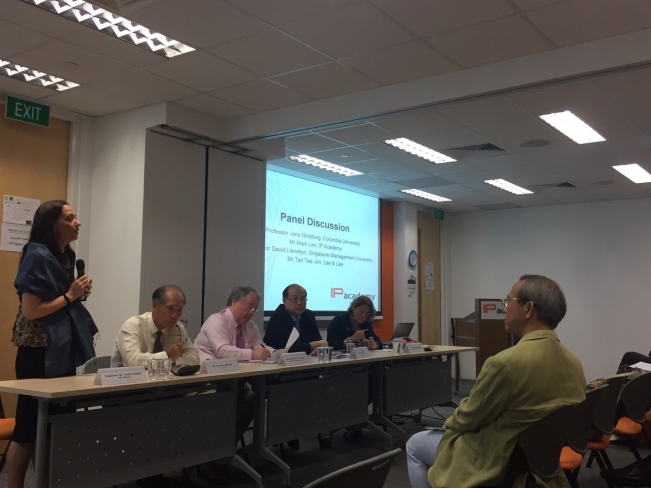
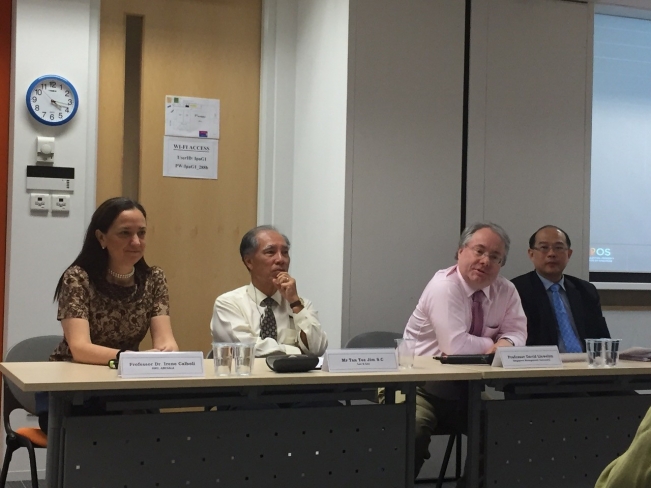
4.05pm - 4.45pm: Panel Discussion
- Professor Jane Ginsburg, Morton L. Janklow Professor of Literary and Artistic Property Law, Columbia University School of Law
- Mr. Mark Lim, Director, Hearings and Mediation Group, IPOS; Senior Faculty/Senior Legal Counsel, IP Academy
- Professor David Llewelyn, Deputy Dean, School of Law, Singapore Management University
- Mr. Tan Tee Jim S.C., Senior Partner, Lee & Lee
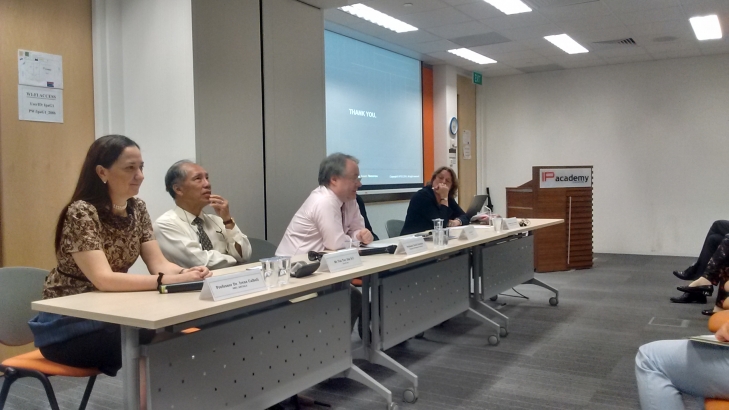
4.45pm - 5.00pm: Discussion and Q & A moderated by Professor Irene Calboli, Deputy Director, Applied Research Centre for Intellectual Assets and the Law in Asia (ARCIALA), Singapore Management University
5.00pm - 5.05pm: Closing Remarks by Professor Liu Kung-Chung, External Director, Applied Research Centre for Intellectual Assets and the Law in Asia (ARCIALA), Singapore Management University
5.05pm - End of Event
Public CPD Points - 2 points
This programme is an Accredited CPD Activity under the SILE’s CPD Scheme. Participants who wish to claim CPD Points are reminded that they must comply strictly with the Attendance Policy set out in the CPD Guidelines. This includes signing-in on arrival and signing-out at the conclusion of the activity in the manner required by the organiser, and not being absent from the entire activity for more than 15 minutes. Participants who do not comply with the Attendance Policy will not be able to obtain CPD Points for attending the activity. Please refer to http://www.silecpdcentre.sg for more information.
Click here for the newsletter and registration link.
Jointly organized by the Applied Research Centre for Intellectual Assets and the Law in Asia (ARCIALA) and the IP Academy (IPA)







Last updated on 23 Jan 2017 .
