





Synopsis
Copyright was originally intended as a mean to secure that authors could create freely, protecting them from the interference of others and from all risk of censorship. Copyright was meant to be “the engine of free expression”, to use the words of the US Supreme Court. To this end, a balance was conceived between exclusive control and freedom, with the overall aim of ensuring the common good: to enable future creativity, some uses were kept outside the control of the right owner through limitations to the exclusive right. These limitations have always played an essential role, alongside the exclusive right, in providing a good and vital creative environment. However, none of the existing systems of limitations in the various jurisdictions was specifically designed to address the creative reuse of copyrighted material in the context of derivative works. On the contrary, when an author intends to create a new work based on another and when some of the expression of a previous work needs to be borrowed, he often will need the authorization of the copyright owner of the original work. This situation might resemble private censorship, as private entities or individuals have the potential to decide what can be created or not and to block the dissemination of new works. It might thus be questionable how this situation can be reconciled with either the copyright’s rationale of incentivizing creativity or the obligations imposed on States by human rights such as freedom of expression and freedom of artistic creation. In this paper, the different options available for legislators and courts to secure creative uses in the context of derivative works will be assessed in order to develop a satisfying legal mechanism de lege ferenda.
SPEAKER
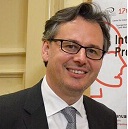
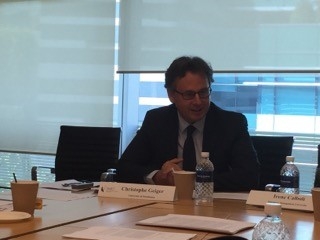
Christophe GEIGER is Professor of Law, Director General and Director of the Research Department of the Centre for International Intellectual Property Studies (CEIPI) at the University of Strasbourg (France). In addition, he is an affiliated senior researcher at the Max Planck Institute for Innovation and Competition in Munich (Germany) as well as Spangenberg Fellow at the Spangenberg Center for Law, Technology & the Arts, Case Western Reserve University School of Law in Cleveland (US). He specializes in national, European, international and comparative intellectual property law, acts as external expert for the European Parliament and the European Union Intellectual Property Office (EUIPO), has drafted reports on IP for the European and international institutions and taught as visiting professor in several universities. He is also General Editor of the Collection of the CEIPI published by LexisNexis, co-editor of the EIPIN series published by Edward Elgar, co-editor of the CEIPI-ICTSD Publication Series on “Global Perspectives and Challenges for the Intellectual Property System” and member of the editorial board of several journals on IP law. He has published numerous articles as well as authored and edited many volumes in this field, the most recent being “Criminal Enforcement of Intellectual Property: A Handbook of Contemporary Research” (2012), “Constructing European Intellectual Property: Achievements and New Perspectives” (2013), “Research Handbook on Human Rights and Intellectual Property” (2015) by Edward Elgar, and “What Patent Law for the European Union?” (2013), “The Contribution of Case Law to the Construction of Intellectual Property in Europe” (2013, in French); “Intellectual Property Law in a Globalized World” (with Caroline Rodà, 2014), “The Intellectual Property System in a Time of Change: European and International Perspectives” (2016), by LexisNexis.
COMMENTATOR

Irene CALBOLI is Lee Kong Chian Fellow, Visiting Professor, and the Deputy Director of the Applied Research Centre for Intellectual Assets and the Law in Asia (ARCIALA), School of Law, Singapore Management University. She is also a Professor of Law at Texas A&M University School of Law. Professor Calboli started her academic career at the University of Bologna and has held visiting positions at the King’s College London, the University of California Berkeley, the University Complutense, and the Max-Planck-Institute for Innovation and Competition. Most recently, she was a visiting professor at the Faculty of Law of the National University of Singapore. Irene’s scholarship focuses on the intersection between intellectual property and international trade. Her recent books include TRADEMARK PROTECTION AND TERRITORIALITY CHALLENGES IN A GLOBAL ECONOMY (Edward Elgar, 2014, with E. Lee), DIVERSITY IN INTELLECTUAL PROPERTY: IDENTITIES, INTERESTS, AND INTERSECTIONS (Cambridge University Press, 2015, with S. Ragavan), and RESEARCH HANDBOOK ON INTELLECTUAL PROPERTY EXHAUSTION AND PARALLEL IMPORTS (Edward Elgar, forthcoming 2016, with E. Lee).
MODERATOR

Wee Loon NG-LOY is a Professor at the Faculty of Law at National University of Singapore. Her main research interests lie in the field of Intellectual Property (IP) Law. She teaches "Law of Intellectual Property" which focuses on Singapore's IP regime, as well as "International Trademark Law and Policy" and "International Copyright Law and Policy". Amongst her academic publications is the text on Law of Intellectual Property of Singapore (2nd ed, 2014). Outside of the university, her involvement in the Iegal landscape of Singapore includes the following: a member of the Resource Panel for Government Parliamentary Committee for Law and Home Affairs (1999-2000); a member of the Board of Directors of the Intellectual Property Office of Singapore (2000-2001); a member of the Board of Governors of the IP Academy (2007-2011); a member of the Senate of the Singapore Academy of Law (2012-2014); a member of Singapore's Copyright Tribunal (since 2009); a member of the Singapore Domain Name Dispute Resolution Policy Panel (since 2014); IP Adjudicator with the Intellectual Property Office of Singapore (since 2014).
Programme
3.00pm - Tea reception
3.30pm - Seminar commence
6.00pm - End of event
This event is by invitation only.
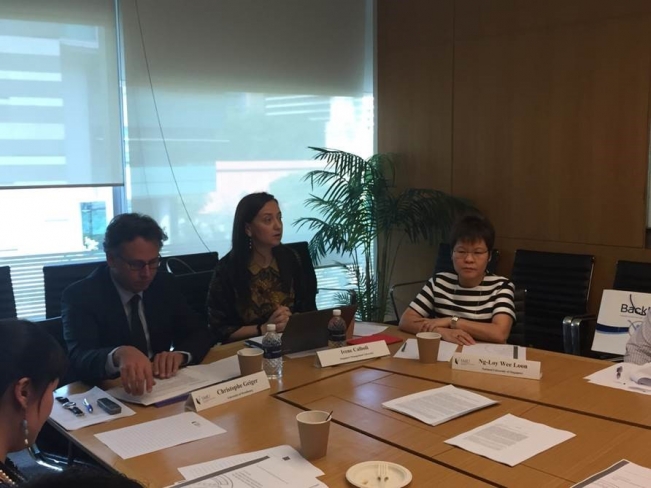
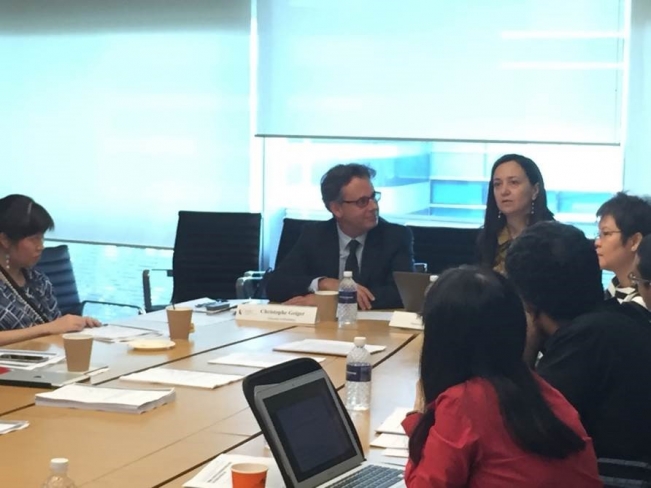







Last updated on 14 Sep 2016 .
